



An investigative report where emails show little rent, district-paid utilities and unanswered questions about public benefit.
By Rebecca Wallis
Newberg, OR – April 16, 2026
A broader public cost is coming into focus
What began as questions about who is living on Chehalem Park and Recreation District property is developing into something much larger.
Yamhill County News has found that, outside of three known contract-based arrangements, district-owned residential and commercial properties are being occupied or used without rent being collected from the tenants or users. District responses also show that CPRD is paying most utility costs at several occupied sites and remains responsible for major long-term maintenance on all properties. Many hours are still being spent on each property despite the arrangement for “caretaking” as stated in emails from CPRD.
The public issue is no longer just occupancy. It is the growing tax burden associated with public assets being used without meaningful reimbursement or revenue generation.

Only three known exceptions to the no-rent pattern
Based on the records reviewed so far, there appear to be only three known exceptions to the broader pattern of no rent being collected on occupied or used district properties.
One is the Wilsonville Road property, where occupancy is tied to the golf superintendent’s employment contract. Another is the Chehalem Cultural Center, which is under contract with the Chehalem Center Association. The third is the Youth Center at the Armory, where district records indicate a nonprofit church pays for exclusive use of the smaller, separate facility on the property.
Outside of those three contract-based arrangements, CPRD has confirmed it has no written leases or rental contracts in place for the remaining occupied district-owned properties reviewed so far. In April 2026, CPRD stated that no written lease agreements had yet been executed for authorized caretakers residing at district properties and that written agreements were still being drafted for employee caretakers, non-employee caretakers, and nonprofit or commercial tenants.
District records identify multiple occupied CPRD properties
A district occupancy list identifies people residing at Bob & Crystal Rilee Park, the Brillas property and the Chehalem Glenn Golf Course property. The list identifies occupancy at 10500 N.E. Parrett Mountain Road, 12075 N.E. Parrett Mountain Road, 17800 N.E. Chehalem Drive and 30265 Wilsonville Road.
One of those properties, Brillas, has become a key example of how informal some of the arrangements appear to be.
In a May 2025 email, the district superintendent stated that a CPRD finance employee lives and serves in an added caretaker role at the Brillas property, receives $0 in monetary compensation for those caretaker duties and pays $0 in monthly rent to live there. The superintendent said the caretaker duties include maintenance of the residence interior, groundskeeping and improvements to the property grounds. The last two board packets show over 30 hours of upkeep work being done by other CPRD employees on the Brillas property.
Later, the superintendent stated that no written lease, rental or tenant agreement exists for that occupancy and said the arrangement had been authorized by a former superintendent. In an earlier response to a public records request, CPRD also stated it could not locate a lease for the Brillas property.
Utilities are being provided, with no reimbursement shown
The public cost does not stop at free or below-market occupancy.
In an April 15, 2026, response, CPRD stated that occupants of district properties are responsible for day-to-day maintenance, but that the district pays major long-term maintenance costs for all properties. In the same response, CPRD provided a chart showing which properties receive district-paid utilities and whether reimbursement is made. For several occupied district-owned properties, the answer on reimbursement was simple: no.
According to CPRD’s chart, the district provides well water, septic, electricity and gas at 10500 N.E. Parrett Mountain Road, with no reimbursement listed. At 12075 N.E. Parrett Mountain Road, the chart shows well and septic service, with no reimbursement listed. At the Brillas property, the chart shows well, septic and electricity, again with no reimbursement listed. At 30265 Wilsonville Road, the chart shows well, septic, electricity and gas, although that property falls under the golf superintendent’s employment contract.
Taken together, those responses indicate taxpayers are not just providing the public land and structures themselves. In multiple cases, taxpayers also appear to be covering a significant share of the ongoing operating cost of those properties.
The Rilee property adds a lost-revenue dimension
The questions become even more serious at the Rilee property, where records suggest CPRD may not only be absorbing costs, but also giving up income-producing use.
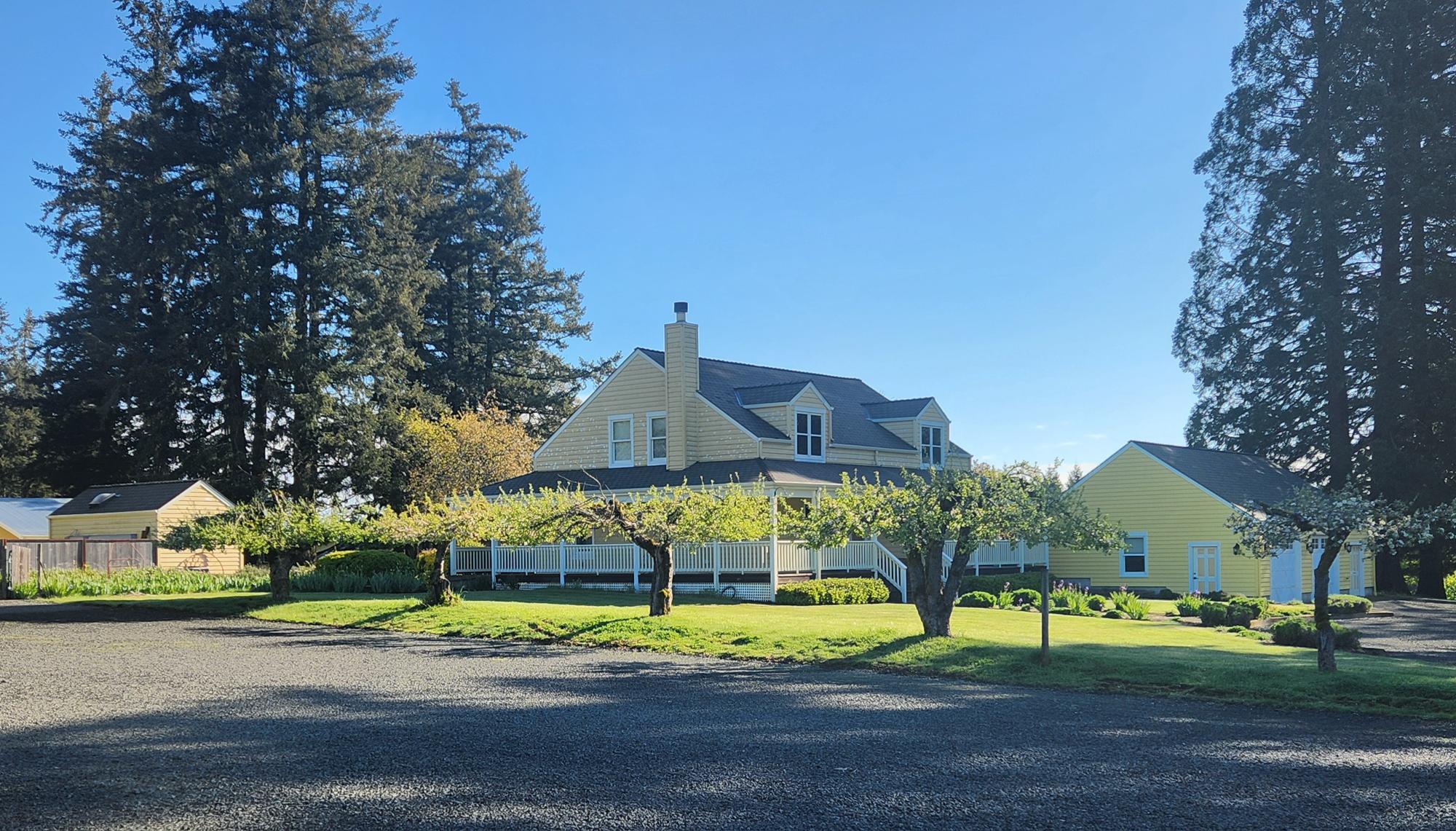
In an April 16, 2026 email, a former Crystal Rilee Foundation board member described the yellow house at 10500 N.E. Parrett Mountain Road as the Farmhouse and event venue. A source familiar with former Foundation operations said the property was “transformed into a versatile event venue” after a 2007 renovation that added office space, meeting space, an upstairs bridal suite, additional bedrooms, a commercial kitchen, an ADA restroom, storage, and outdoor event amenities. According to the source, the venue hosted weddings, corporate meetings, family reunions, birthday parties, summer camps, educational programs and other large public events.
The source said weddings rented for “$10,000 per weekend,” and that the site also hosted the Linfield College Parrett Mountain Farm Archeological Field School in 2009, bringing in “a total of $8,000.” Other uses described by the source ranged from kids’ summer camps to Art in the Woods, the Sheriff Posse Poker Ride, and a Civil War reenactment that drew 381 participants over a weekend. The same April 16 email identified 12075 as the “Old School House” or “Pink House” and described it as being in serious repair. It was said as the venue needs to stay below a 100 person occupancy to comply with county rules and regulations, the venue was more private and sought after.
That history matters.
A district-owned property that once brought in event revenue is very different from an ordinary residence. If that property is now being used primarily for residential occupancy while taxpayers also shoulder utility and maintenance costs, the public may be losing twice: once in direct expense and again in revenue that is no longer being collected.
No obvious housing-related payroll reporting appears in the records reviewed
The email exchange between Yamhill County News and district staff also raises questions about whether the value of these arrangements is being reflected anywhere in district payroll records.
In the January 22, 2026, CPRD board packet, the district’s budget materials show standard payroll-related categories such as FICA, unemployment and state, retirement, health insurance and workers compensation. But the records reviewed do not show any obvious separate category for housing, lodging or occupancy-related compensation.
In a separate April 15, 2026, payroll response, CPRD identified the district’s Finance/HR Specialist as the person who runs payroll and payroll reports. Earlier, CPRD also stated that no 1099 was planned for issuance to tenants residing at district properties.
The records reviewed by Yamhill County News do not by themselves establish whether internal tax or payroll decisions were made elsewhere and simply not reflected in the materials provided. But the responses do not show any clear indication that rent-free housing, utilities or similar occupancy-related value was being separately identified in the payroll materials reviewed so far.
A pattern of informal arrangements on public property
Standing alone, one unusual property arrangement might be explained away as an oversight or a holdover from prior management.
But the records reviewed so far point to something broader: multiple district-owned properties being occupied or used with little written documentation, little apparent reimbursement and, in most known cases, no rent at all. At the same time, CPRD has acknowledged district-paid utilities at several occupied sites and district-paid major long-term maintenance across all properties.
That creates an obvious public accountability question. If CPRD is allowing occupancy on taxpayer-owned property without leases, without rent, and without reimbursement for utilities in most known cases, what exactly is the district receiving in return, and how was the public interest protected?
The financial risk may go beyond rent and utilities
Beyond lost rent and utility costs, these arrangements may also carry risk. Based on the records obtained so far, there does not appear to be clear written documentation addressing insurance, liability, damage, indemnification or responsibility if something goes wrong on district property. If public assets are being occupied or used without those protections clearly in place, taxpayers may be exposed not only to ongoing costs, but to avoidable legal and financial risk as well.
Who gets access and who does not
The contrast is hard to ignore. Members of local veterans’ organizations have sought space for years. Yet CPRD has allowed other entities to use public property under more favorable terms. A church pays rent for the Youth Center, while a district-provided chart shows Habitat for Humanity does not pay rent for use of the Armory, despite being an organization with access to substantial revenue and grant funding. Given the Armory’s historic military connection, the disparity raises broader questions about who receives favorable treatment, how those decisions are made, and whether taxpayers are subsidizing select users of public property.
This story is still developing
The information received and reviewed by Yamhill County News do not yet answer every question.
They do not fully establish the annual dollar value of utilities paid by CPRD for each occupied property. They do not show how the district determined fair market value, if it did so at all. They also do not resolve whether the district evaluated the opportunity cost of using revenue-capable properties for residential occupancy instead of public or income-producing use.
But they do show enough to make one thing clear: taxpayers appear to be shouldering real costs tied to occupancy and use of CPRD-owned properties, while the district in most known cases reviewed so far is collecting no rent in return.
Yamhill County News will continue pursuing additional records and responses related to utility costs, maintenance expenses, fair market value, forgone rental income and the decision-making that allowed these arrangements to continue.
Photo Credit: Yamhill County News File
Discover more from Yamhill County News
Subscribe to get the latest posts sent to your email.


Thank you for your research.
As the resident caretaker of Bob and Crystal Rilee Park, I would like to provide a ‘boots-on-the-ground’ perspective. I want to start by saying that I completely understand and share this community’s desire for transparency. As a taxpayer myself, I believe every public dollar and asset should be managed with the highest level of responsibility. Hence, I’d like to provide some context for considering how this arrangement may actually function as a cost-saving measure for the District.
My spouse and I do not see ourselves as just residents; we are stewards of this historic property. We stay here under a formal rental agreement that trades labor for reduced rent—a common, cost-effective practice for protecting remote public parks. It is also important to consider the property’s unique history: CPRD secured this 327-acre park and its 3,000 sq. ft. farmhouse for just $280,000—a fraction of its $6,000,000 million value—thanks to a massive donation from the Crystal Dawn Smith Rilee Foundation.
Our role as resident caretakers is a low-cost way to protect that multi-million dollar public investment. Rather than looking at the farmhouse as a lost rental opportunity, it is more accurate to see it as a strategic security hub that allows the District to preserve a massive community gift without the overhead of 24/7 paid staffing. While $4,000 might be the Fair Market Value (FMV) for a private rental, that ‘value’ assumes the tenant has total privacy and zero chores. Because we are required to manage gates, monitor for vandalism, and perform hours of labor, this isn’t a standard rental—it’s a work-site residence.
Here is a list of year-round services my spouse and I provide that replace taxpayer expenses:
* Year-Round Gate & Facility Management: Every single day of the year, we manage the upper parking lot. By being on-site to lock and unlock the gates at 7:00 a.m. and dusk, we save the District from sending up an employee and truck from Newberg for two round trips daily. This eliminates thousands of miles of vehicle wear and hundreds of hours of paid staff travel time annually.
* High-Intensity Seasonal Labor: During the seven to eight months of the growing and ‘active’ season, we contribute 15 to 30 hours of labor per week (separately or combined) on yard work, and occasionally more as needed for facility cleaning, repairs, and exterior weather-proofing. This ‘sweat equity’ replaces the need for the District to send up seasonal crews during the most expensive time of year.
* 24/7 Security & Surveillance: Remote parks are high-risk areas for vandalism and dumping. Replacing a live-in presence with professional 24/7 security or nightly patrols would cost the District thousands a year. We provide this deterrence at zero labor cost and are the only 911-callers within earshot. We’ve managed everything from reporting branches hanging from power lines to assisting employees in medical emergencies.
* Asset Stewardship: We have personally mapped lost irrigation systems, managed pest contamination, and researched the park’s history to assist visitors—tasks that ensure the property is preserved for future public use. We have researched the former owners’ vision and take pride in acting as unofficial docents for visitors. Our goal is to hand this property back to the public in better shape than we found it.
While we live here at a lower cost than a traditional rental, we do so as a single-income household earning well below the state median, dedicating our free time to maintaining a public asset. We consider it an honor to protect this property, and we believe this arrangement is a win-win that helps keep Bob & Crystal Rilee Park safe and beautiful at a fraction of what it would cost to staff it 24/7.
We truly believe Bob & Crystal Rilee Park is a community treasure that shouldn’t go to waste. We are working hard to get the property in top shape for a future time when the District decides it is the right timing for more public events to happen here. Until then, we hope to see you out on the trails or enjoying the irises bloom—that’s what all this hard work is really for. If you see us out pruning the apple trees or working on the grounds, please feel free to stop and say hi—we’d love to share some of the park’s history with you or show you around. You’re also welcome to bring some gloves and help us with the weeding–there is always plenty to go ’round. I find it quite therapeutic after a long afternoon in the comment section.
Who is recieving the rent you supposedly pay? The chart in the article says no text is exchanged.
As your rental agreement would be a public record, can you provide a copy to the public? CPRD says you have no agreement.